Every installer has had this argument with themselves. Show a price, and you might scare people off, let competitors undercut you, or get held to a number that does not fit the job. Hide it, and homeowners leave your site for one that tells them something.
There is no single right answer, but there is a right answer for your trade and your buyer. This guide sets out the options, what tends to work where, and how to show prices without trapping yourself.
Why buyers want a price before they talk to you
A homeowner looking at a new boiler, a set of windows or a battery has one question before all others: can I afford this? If your site does not give them a clue, they have three choices: ring you and risk a sales pitch, fill in a form and wait, or go to a site that answers it. More and more pick the third.
Direct-to-consumer firms have trained buyers to expect this. In boilers especially, national online companies give a fixed price in a couple of minutes from a few questions and photos. If you are an independent heating engineer competing with them, we cover that in online boiler quote tools for independent installers.
The options, from least to most open
1. No prices at all
Fine when every job is genuinely bespoke (extensions, large commercial solar) and buyers expect a site visit. The risk is that your site gives price-sensitive buyers no reason to stay. If you go this route, at least explain what affects the price and how quickly you can give a written quote.
2. "From" prices
"Battery storage from £X fitted." Simple, but often unhelpful. Almost nobody gets the "from" price, so it can create a bad first impression on the survey. If you use one, show what it includes.
3. Typical price ranges
"Most three-bed semis we fit with a 5kW air source heat pump come in between £X and £Y before the Boiler Upgrade Scheme grant." Ranges are honest, set expectations and filter out people with no budget. They work well for solar, heat pumps, batteries, insulation and most home improvement.
4. Real project examples
"Recent job in Stafford: 4.4kW solar, 5kWh battery, two days, £X." Project-based pricing is believable because it is real. It also gives you great content for town pages and AI search.
5. An instant estimator or quote tool
The buyer answers five to eight questions and gets a price range or a fixed price straight away, in return for their details. This is where most growth is, because it gives the buyer what they want and gives you a qualified lead. We have built instant online quote tools for boiler installers and EV charger installers for exactly this reason.
What tends to work by trade
| Trade | Best fit | Why |
|---|---|---|
| Boilers | Fixed price quote tool | Buyers compare with online firms that give fixed prices |
| EV chargers | Quote tool with a few photos | Jobs are fairly standard, cable run is the main variable |
| Solar and battery | Ranges plus estimator | Roof size and battery choice vary, but ranges are predictable |
| Heat pumps | Ranges with grant shown | The grant changes the buyer's maths |
| Windows and doors | Ballpark estimator | Count, size and style give a decent estimate |
| Kitchens, extensions | Ranges and project examples | Too bespoke for an instant price |
Window and door price tools: buyers or tyre kickers?
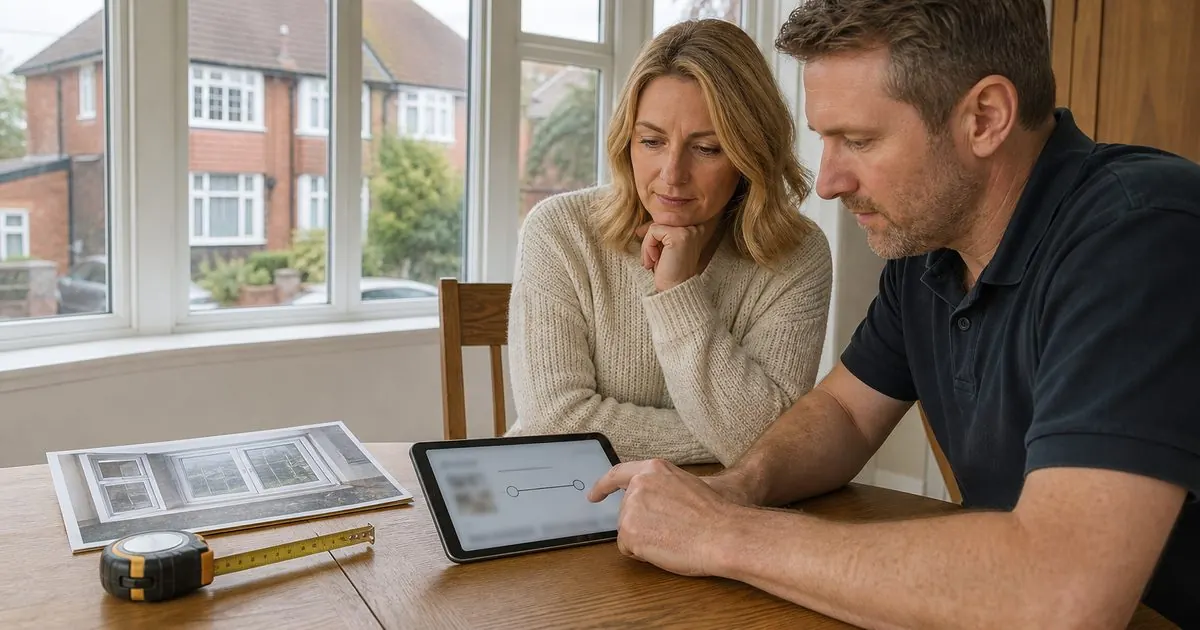
Window installers worry most about this, so it is worth its own section. An online window price tool asks how many windows and doors, rough sizes, material and style, and gives a ballpark figure.
The fear is that it attracts people who just want a number and never buy. In practice, a well-built tool does the opposite of attracting time-wasters, as long as you design it properly:
- Ask for contact details before the figure, but after the questions. People who have invested two minutes answering are more likely to complete.
- Show a range, not a single number, and state clearly that it is confirmed on survey.
- Add one or two qualifying questions at the end: "When are you hoping to have them fitted?" and "Do you own the property?" These sort tyre kickers from buyers instantly.
- Offer the next step on the results page. "Book a free measure-up" with the diary right there.
- Follow up in minutes. The buyer who has just seen a price is at peak interest. A call or WhatsApp straight away, ideally automated, makes the difference. See the 5-minute rule.
Someone who sees a range that is out of their budget and leaves has saved your surveyor a wasted trip. That is the tool working.
How to show prices without trapping yourself
- Be clear about what is included. Scaffolding, removal of the old system, making good, certificates, VAT.
- Say what changes the price. "Long cable runs, a new consumer unit or a flat roof will add to this."
- State that the final price is confirmed on survey, and do not use that as an excuse for big jumps.
- Keep it current. An old price on a page you forgot about does more harm than no price at all. Put a date on project examples.
- Follow the UK rules. Under the Digital Markets, Competition and Consumers Act 2024, the CMA's price transparency guidance says that where a price is shown in a way that lets a consumer make a decision to buy, it must include mandatory charges such as VAT and fees they cannot avoid. If your tool gives a price the customer can accept, build VAT and compulsory charges into it.
If you advertise finance alongside prices, there are separate rules on how finance can be promoted. Speak to your finance provider before adding monthly figures.
How to decide for your business
Ask yourself three questions:
- Do competitors in my area show prices? If they do and you do not, you are at a disadvantage before the buyer reads a word.
- Can I predict the price within a sensible range from a few questions? If yes, an estimator is worth building.
- What happens to price-shoppers now? If your team spends hours on surveys that end with "too expensive", showing a range earlier will save that time.
For the mechanics of building quizzes and calculators that score each lead, see quiz and calculator funnels.
Price tools are one of the things we build as part of our website design and funnel work. If you want to talk through whether one would work for your trade, book a video call and we will look at it with you.
Sources
Questions owners ask
Will showing prices just help my competitors?
Your competitors can already get your prices by asking for a quote. Hiding them mainly affects homeowners, who often leave for a site that gives them a figure. A range or estimator tells buyers whether you are in their budget while keeping the detail for your survey and proposal.
Do UK price rules apply to a price range on my website?
The CMA's price transparency guidance applies when a price is shown in a way that lets a customer decide to buy. If customers can act on a figure you publish, it should include VAT and any charges they will have to pay. For estimates, be clear it is a guide subject to survey. Take advice if unsure.