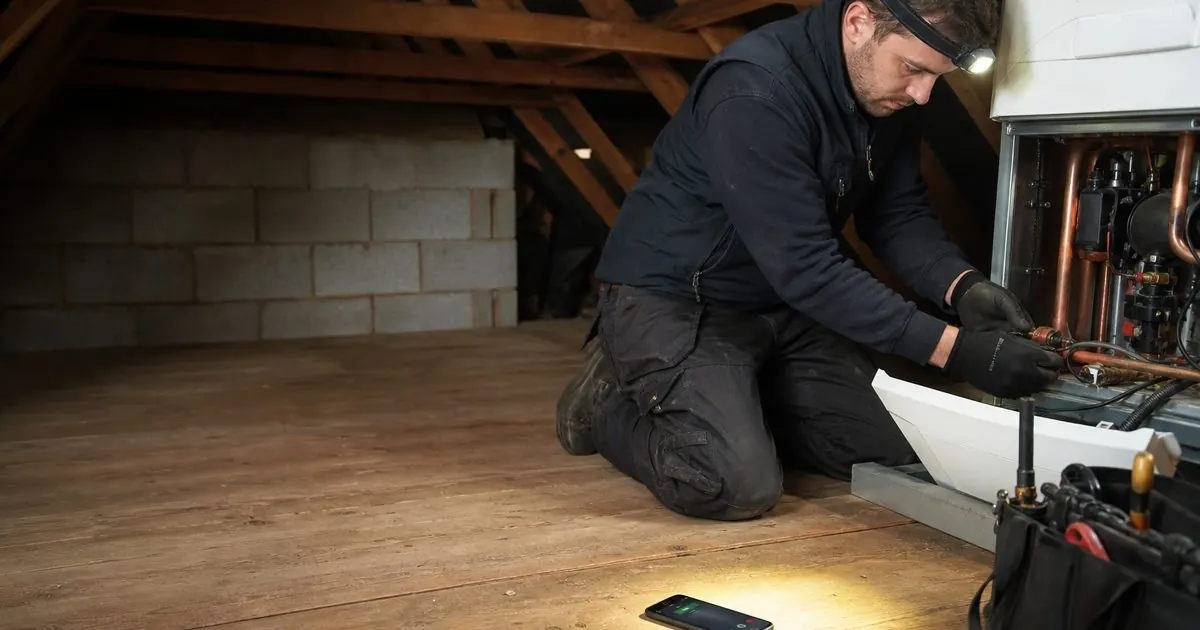
You are in a loft, on a roof or halfway through a consumer unit swap, and the phone rings. You cannot answer. By the time you look at it, an hour has gone, and when you ring back you get voicemail, or a polite "we've sorted it now". Most owners know this happens. Very few know how often, or what it costs them.
This article is about phone calls. If your problem is web forms and Facebook enquiries that sit unanswered, that is a different fix, covered in our piece on speed to lead.
Work out what missed calls cost you
Before you buy anything, get your own numbers. Most phone systems and mobile networks show a call log. Pull the last four weeks and count:
- Calls that rang out or went to voicemail.
- How many of those were numbers you did not recognise (likely new enquiries).
- How many of those callers you managed to speak to later.
- What time of day and day of the week they came in.
Then run a simple sum with your own figures. Say you miss 8 calls a week from unknown numbers. Say half are genuine new enquiries, and you only reach half of those when you ring back. That is 2 lost conversations a week, about 100 a year. If 1 in 4 of those would have become a survey, and you close 1 in 3 surveys, that is roughly 8 jobs a year. Multiply by your average job value. For a solar, heat pump or roofing firm, that number usually ends the debate about whether to fix it.
The pattern matters as much as the total. If the misses cluster between 8am and 10am, you are on the first job of the day. If they cluster after 6pm and at weekends, that is when homeowners have time to ring, and nobody is there.
Why installers miss calls in the first place
It is rarely laziness. It is how the work is built:
- The owner is the phone. In a lot of small firms, every new enquiry rings one mobile, carried by someone who is also fitting, surveying or quoting.
- Ads create spikes. A campaign that goes well brings calls in bursts, often in the evening when ads get the most attention.
- The office closes at 5pm. Homeowners ring when they get home.
- Surveys and sales visits. A rep in someone's living room cannot take another call, and should not.
- Voicemail is dying. Plenty of people hang up rather than leave a message, especially for a firm they have not used before.
Your options, compared
| Option | Covers evenings and weekends | Qualifies the caller | Books the visit | Main risk |
|---|---|---|---|---|
| Voicemail | Yes, in theory | No | No | Most new callers hang up |
| Divert to office or family member | Only while someone is there | Sometimes | Sometimes | Inconsistent, and people burn out |
| Human answering service | Often | Basic questions only | Usually takes a message | You still have to ring back |
| Missed-call text back | Yes | Only if someone replies to the text | Not on its own | The text leads to another wait |
| AI call answering | Yes | Yes, if set up properly | Yes, into your diary | Poor scripts and no human hand-over |
The right answer for many firms is a mix: the team answers when they can, and anything that rings out is caught automatically, either by AI answering or by an instant text that a person or an AI assistant follows up straight away.
What good AI call answering should do
AI voice tools have improved quickly, and the gap between a good setup and a bad one is mostly the setup, not the software. Before you switch one on, check it can do all of this:
- Answer fast and say who it is. "Hi, you've reached Smith Heating, I'm the assistant. How can I help?" No pretending to be a person.
- Find out what the call is about. New enquiry, existing customer, supplier, complaint or emergency. Each needs a different route.
- Ask your qualifying questions, and only those. Postcode, what they want, whether they own the property, rough timescale. The same questions your best office person would ask.
- Check the right diary. If you route work by area, it should offer slots for the rep who covers that postcode, not any free slot.
- Book it and confirm it. A confirmation by text straight after the call, with the date, time and who is coming.
- Hand over cleanly. Anyone who asks for a person, gets upset or has a problem it cannot answer should be passed to your team with an alert, not left in a loop.
- Log everything. The call summary, the answers and the booking should land on the lead in your CRM, so whoever rings them next knows the story.
Set the rules before the first call
The work is in writing the playbook. Sit down with whoever answers your phone best and write out:
- The questions they ask, in order.
- The answers they give to the ten most common questions (price ranges, areas covered, how long installs take, finance, grants).
- What counts as an emergency for your trade and what happens then. For a heating firm, anyone reporting a smell of gas should be told to ring the gas emergency line immediately, not offered a survey slot.
- Who gets alerted for hand-overs, by text or app, and what happens out of hours.
- What the assistant must never do: quote a firm price, promise a grant, diagnose a fault, or offer anything you do not actually provide.
Then test it. Ring it yourself as an awkward customer, a confused older caller, someone who only wants a price and someone who is angry. Fix the gaps before a real customer finds them.
The missed-call text: the minimum fix
If you are not ready for AI answering, set up an automatic text to anyone whose call rings out. Keep it short and give them an easy next step:
Hi, it's Smith Heating. We're on a job right now. What can we help with? Reply here and we'll get straight back to you, or book a time that suits you: [link]
Send it by SMS. It is tempting to use WhatsApp, but WhatsApp's business policy says you may only message people who have given you their number and opted in to hear from you. A phone call on its own is not a clear opt-in. Once they reply and the conversation is open, you can move to WhatsApp if they prefer it. We explain the WhatsApp rules in our WhatsApp guide for installers.
The text only works if the reply gets answered quickly. That is where an AI assistant earns its keep: it can pick up the reply in seconds, ask the questions and offer slots, rather than the text sitting there until you finish the job.
Recording and transcripts
Most AI answering tools record or transcribe calls. That is personal data. Tell callers at the start that the call is recorded or handled by an assistant, explain it in your privacy notice and agree how long recordings are kept. The ICO's guidance on monitoring calls expects people to be told. We cover this properly in our guide to AI, call recording and GDPR.
Busy seasons make this worse
Missed calls are a background leak most of the year and a flood in a surge: the first hot week for air conditioning, a storm for roofers, the first cold snap for boilers. If you are in one of those trades, get the answering sorted before the season, not during it. Our seasonal pieces on heatwave demand and storm weeks cover the campaign side.
Where we fit
We build the reply and booking side of this as part of the system: an AI assistant that replies to new enquiries in seconds, day, night and weekends, asks your qualifying questions and books the visit into the right rep's diary, with every conversation saved in Installer Flow, our own CRM. Eco Green Energy Group used it instead of hiring office staff to book appointments. Their MD, Ewan McNeil: "A lot of the enquiries come in at a weekend and late at night. It helps us close more deals."
If calls are your biggest leak, bring your call log to a video call with us. We will work through the numbers with you and talk about how your phone line fits with the rest of the follow-up.
Sources
- ICO: data protection considerations for monitoring, including recording calls
- WhatsApp Business Messaging Policy (Meta), opt-in rules
- Meta for Developers: getting opt-in for WhatsApp
Questions owners ask
Should an AI call answerer pretend to be a person?
No. It should say it is the assistant for your business in its first sentence. Callers are far more forgiving of a helpful assistant than of one they catch pretending. Being upfront also fits the transparency rules under UK GDPR, and it makes the hand-over to a real person feel natural rather than like a trick.
Is a missed-call text enough on its own?
It is the minimum, and far better than nothing. A text within a minute catches a lot of callers who would otherwise ring the next firm. But it only works if someone, or something, replies to their answer straight away and moves them towards a booked visit. A text that leads to another wait just delays the loss.
What should happen with emergency calls?
Decide the rules before you switch anything on. For a heating firm, a smell of gas means telling the caller to ring the gas emergency line straight away, not booking a survey. Water leaks, no heating for a vulnerable customer and electrical faults should go straight to a person, with an alert to whoever is on call.