"Will I need planning permission?" is one of the first questions a conservatory roof buyer asks, and one of the most common reasons they stall. Some assume yes and give up. Some assume no and get surprised by building control. Some read a forum thread from 2014 and get confused. Meanwhile your quote sits in their inbox.
You can take most of that friction away by answering the question properly, in writing, before the survey. This guide sets out the current position in England (as of November 2026), then shows how to turn it into a page, an automatic message and a survey checklist. It isn't legal advice, and the final word always sits with the customer's local authority.
Planning permission: usually the smaller question
Conservatories follow the same planning rules as other house extensions. If a conservatory sits within permitted development limits, it doesn't need planning permission. The Planning Portal sets out the main limits: extensions can't cover more than half the land around the original house, can't be higher than the existing roof, have height limits near boundaries, and have depth limits for single-storey rear extensions.
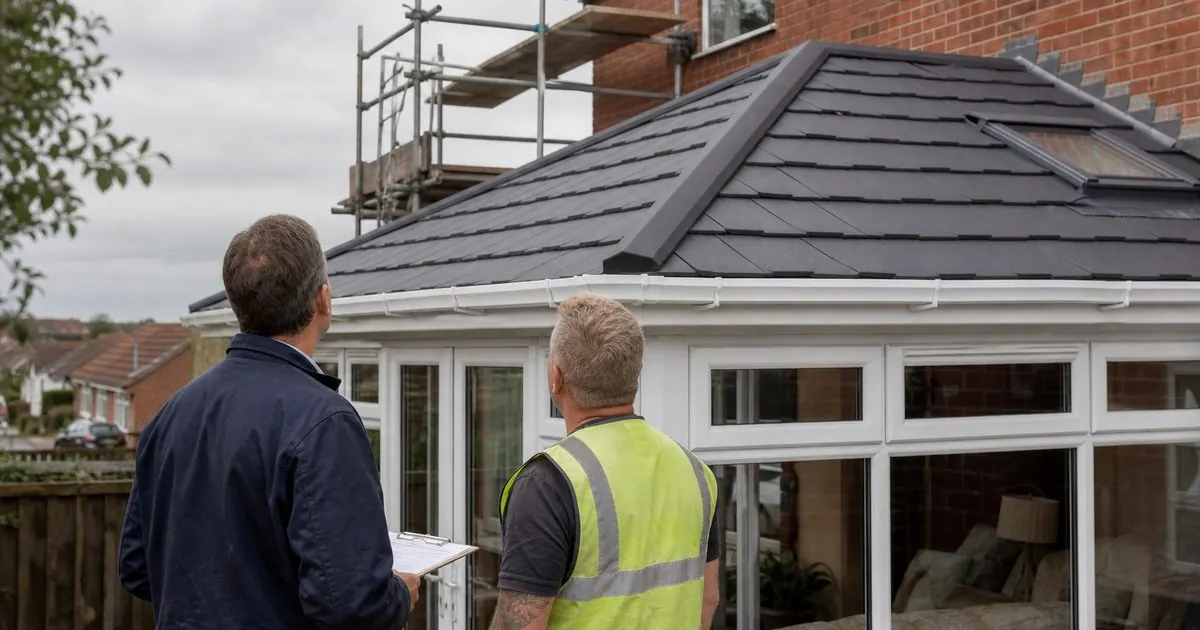
For a roof replacement on an existing conservatory, where the footprint stays the same and the new roof doesn't go higher than those limits allow, planning permission is often not required. The common exceptions to flag:
- Listed buildings. Listed building consent is likely to be needed for external changes.
- Flats and maisonettes. Householder permitted development rights don't apply in the same way.
- Conservation areas and other designated land, especially where an Article 4 direction removes permitted development rights.
- Homes where permitted development rights were removed by a condition on an earlier planning permission, which is common on newer estates.
- A bigger or taller structure. If the "roof replacement" is really a rebuild that changes the size or height, it is a new extension and the normal rules apply.
If any of these apply, tell the buyer to check with their council before they commit. The government's technical guidance on permitted development is the reference point.
Building regulations: usually the bigger question
Here is where buyers get caught out. Conservatories are normally exempt from building regulations, according to the Planning Portal, when they are:
- Built at ground level and less than 30 square metres in floor area.
- Separated from the house by external quality walls, doors or windows.
- Heated, if at all, by an independent system with its own controls.
- Single storey, with glazing and any fixed electrics that comply with the relevant rules.
Approved Document L sets out the same exemption from the energy efficiency requirements, including that the house's heating system must not extend into the conservatory.
The key point for roof replacements comes from LABC's guidance on solid roofs to conservatories. It explains that a conservatory needs a significant proportion of its roof and walls glazed to count as exempt. When work significantly reduces the glazing or translucence of the roof, the conservatory can no longer be treated as exempt, and the new roof has to comply with the building regulations.
In practice, LABC says building control is likely to look at:
- Structure (Approved Document A). Whether the existing foundations can take the extra load, often checked with trial holes, and whether the existing window frames are reinforced enough to carry the roof, or need new posts.
- Weatherproofing (Approved Document C). The roof, abutments with the house and rainwater goods.
- Energy efficiency (Approved Document L). The new roof should meet the standards for a new thermal element, with the rest of the conservatory no worse than before.
LABC also notes that some lightweight solid roof systems hold LABC Assured certification (previously LABC Registered Details), which can make approval more straightforward.
Two more points worth telling buyers:
- Knocking through is separate. Any new structural opening between the conservatory and the house needs building regulations approval, even if the conservatory itself is exempt.
- Heating changes matter. Extending the house's central heating into the conservatory removes the exemption. If the plan is to add radiators off the main system, building control needs to know.
Approval can come from the local authority building control team or a registered building control approver. Whoever signs it off, the customer should get a completion certificate. Their solicitor will ask for it when they sell.
Turn the rules into a page buyers can trust
A vague "we handle everything" doesn't reassure anyone who has read a forum thread. A clear page wins trust and saves your surveyors repeating themselves. Structure it like this:
- The short answer. "Most roof replacements on houses don't need planning permission. Most solid roof replacements do need building regulations approval, and we arrange it for you."
- When planning might apply, using the exceptions list above.
- What building regulations mean for your roof, in plain English: the checks on the base, frame and roof, and who does them.
- What we do and what you'll receive, including the completion certificate.
- What it means for timing, so they aren't surprised.
- Links to the official sources, so they can check for themselves.
Answer the questions in the first sentence of each section. Search engines and AI tools quote pages that answer directly, and buyers trust a firm that links to the Planning Portal rather than asking them to take its word for it.
Send it automatically after every enquiry
Don't wait for the buyer to ask. Set your CRM to send a short message straight after the enquiry, with a link to the page and a three-line summary. Follow it with a pre-survey checklist so the visit runs smoothly and nothing surprises anyone later.
A good pre-survey checklist for the homeowner:
- Is the house listed, in a conservation area, or a flat?
- Do you know if there were any planning conditions when the house or conservatory was built?
- Is there a door or window between the house and the conservatory, and do you want to keep it?
- Is the conservatory heated, and if so, by what?
- Do you want to add lights, sockets or heating as part of the work?
- Can you send a few photos of the outside, the roof and where it meets the house?
Give surveyors the same script
Your surveyors should give the same answer as your page and messages. Brief them to check the frame for reinforcement, look at the base and foundations, ask about heating and the door to the house, and note anything that could affect planning. Log it all in the CRM so the quote reflects any building control work and the buyer isn't hit with surprises later.
How we help
We build conservatory roof websites with clear, sourced FAQ pages, set up automatic follow-up that sends the right information after every enquiry, and connect it to campaigns that reach owners with unused conservatories. See our conservatory roofs page and website design service.
If buyers keep stalling on the rules question, book a video call and we'll look at how your site and follow-up answer it now.
Sources
- Planning Portal: Conservatories, planning permission
- Planning Portal: Conservatories, building regulations
- GOV.UK: Permitted development rights for householders, technical guidance
- GOV.UK: Conservation of fuel and power, Approved Document L
- LABC guidance on solid roofs to conservatories (hosted by Ribble Valley Borough Council)
Questions owners ask
Does replacing a conservatory roof with a solid roof need planning permission?
Often not, when it's a house, the footprint stays the same and the new roof stays within the original limits. Exceptions include listed buildings, flats, some conservation areas with Article 4 directions, and homes where permitted development rights were removed. Always tell buyers to check with their council if any of those apply.
Does a solid conservatory roof need building regulations approval?
Usually, yes. LABC's guidance says that when work significantly reduces the glazing in the roof, the conservatory can no longer be treated as exempt. The roof then has to meet the regulations, including structure, weatherproofing and energy efficiency, and building control will check it. Some roof systems carry LABC Assured certification, which can simplify this.
Who applies for building regulations approval for a conservatory roof?
Usually the installer arranges it on the customer's behalf, either with the local authority building control team or a registered building control approver. Tell the customer this up front, and make sure they receive the completion certificate. They will need it when they sell the house.