Most installers who add commercial solar to a domestic business do the same thing first. They copy their best homeowner ad, swap "your home" for "your business", point it at the same landing page and wait. What comes back is a mix of sole traders working from a spare room, people asking about their house, and the odd shop owner who rents a unit and has never asked the landlord. Very few of them own a big roof, use power in the day and have the authority to spend six figures.
That is not bad luck. Commercial solar is a different sale, to a different buyer, with different money behind it. This post explains what changes and what a commercial lead generation setup should look like instead.
The buyer is not a homeowner with a bigger roof
A homeowner decides with their partner, often in a couple of weeks, and the trigger is usually a bill, a neighbour's install or a finance offer. A business decides in a committee, over months, and the trigger is usually an energy contract renewal, a cost-cutting review or a customer asking about their carbon footprint.
| Domestic solar | Commercial solar | |
|---|---|---|
| Who signs | Homeowner, maybe a partner | MD, finance director, sometimes a board or landlord |
| Time to decide | Days to weeks | Months, sometimes over a year |
| What they compare | Price, panels, battery, reviews | Payback, cash flow, tax treatment, disruption, risk |
| VAT | 0% on installs in residential accommodation until 31 March 2027 | Standard rate in most commercial buildings |
| Government loans | Warm Homes loans may apply | Not eligible: the scheme is for residential property |
| Key data | Roof photo and a bill | Half-hourly usage data, roof condition, lease, grid capacity |
Two lines in that table matter for your marketing straight away. The 0% VAT rate in HMRC's Notice 708/6 covers energy-saving materials installed in residential accommodation (and buildings used solely for a relevant charitable purpose). Most commercial buildings pay the standard rate, so do not borrow homeowner messaging about VAT savings. And the Warm Homes Loan Scheme is for residential property only: GOV.UK states commercial property is not eligible, and the scheme rules say lending to businesses or SPV structures is not allowed. If your domestic ads mention Warm Homes loans, keep that well away from your commercial campaign.
Why homeowner tactics fail for business roofs
Broad social targeting finds the wrong people
Domestic solar works on Facebook and Instagram because almost every adult in a postcode is a possible buyer. In commercial, the possible buyers in your patch might number in the hundreds. Broad targeting reaches staff, not owners, and the people who do click are often tiny businesses with no roof of their own.
A three-question form tells you nothing
"Do you own your home? What is your postcode? What is your monthly bill?" is enough to book a domestic survey. For commercial, a site survey is a half day for a senior person. You need to know far more before anyone drives out.
The proof is wrong
Photos of a nice semi with twelve panels do not persuade a factory owner. They want to see a roof like theirs, a business like theirs and numbers a finance director would accept. More on that in Commercial solar case studies that actually persuade other businesses.
What works instead
1. Search ads for people already looking
The cleanest commercial leads come from people typing what they want into Google. Think "commercial solar installer" plus a county, "solar panels for warehouse", "solar PV for farm buildings", "business solar quote" and "solar for factory roof". These searches are low in volume but high in intent.
Two rules make Google Ads work here. First, a hard negative keyword list for domestic terms ("house", "home", "bungalow", "grant", "free") so you are not paying for homeowners. Second, separate ad groups by building type, each sending people to a page about that type of building.
2. A landing page built for businesses, not homeowners
The page should look like it was written for an MD with ten minutes. That means:
- Headline about the business problem: daytime electricity costs, price risk at contract renewal, or customer pressure on carbon.
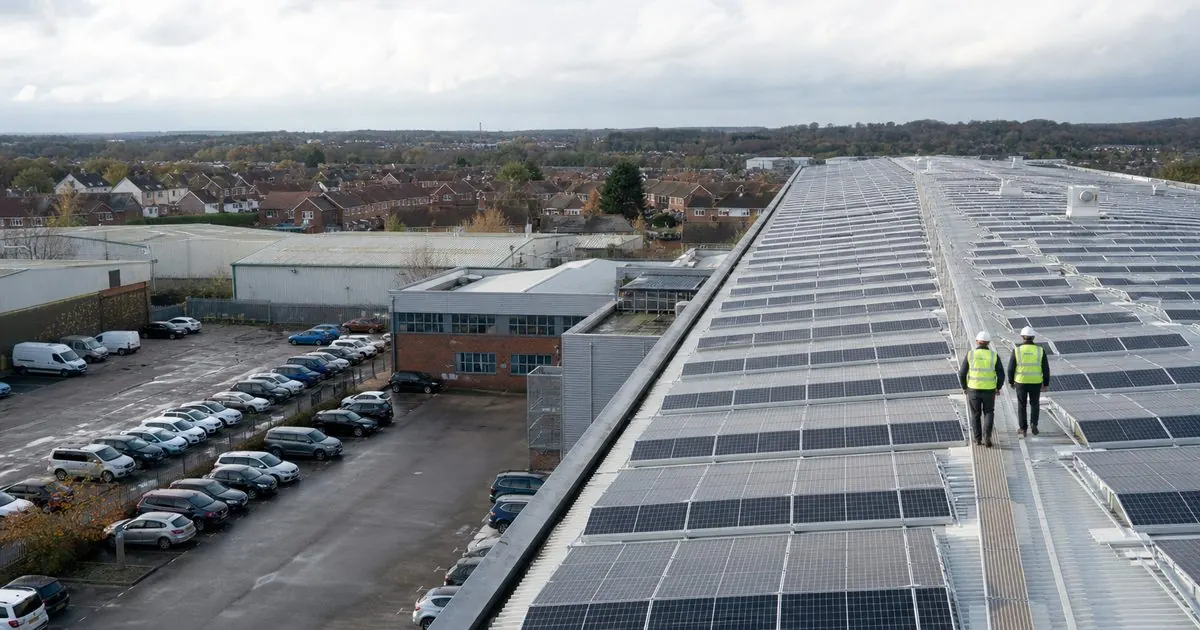
- Projects by building type: warehouses, farms, manufacturing, offices, care homes. kWp, annual generation and the share of daytime use covered, where the client agreed to share it.
- A short section for the finance director: how payback is worked out, what tax treatment to ask their accountant about, and what the proposal will include.
- A clear next step that is not "get a free quote". "Book a 20-minute feasibility call" or "Send us your last 12 months of usage" reads as more serious.
3. A form that qualifies the site
These are the questions worth asking before a commercial survey. Keep the first one easy and high-intent, and the sales funnel can ask the rest step by step:
- What type of building is it (warehouse, factory, farm, office, retail, other)?
- Do you own the building, or lease it? If leased, how long is left on the lease?
- Roughly what do you spend on electricity a year?
- When does your current energy contract end?
- Is most of your electricity used in the day, Monday to Friday?
- Roughly how big and how old is the roof?
- What is your role, and who else would be involved in the decision?
Question 2 sorts out the tenant problem early (see [[COM-4]]). Question 4 gives you a date to follow up against, which matters in a long cycle (see [[COM-2]]).
4. Social ads, used differently
Meta can still work for commercial solar, but treat it as a way to reach owners of local businesses with proof, not as a mass lead machine. Short videos of a real business owner on their own roof, run tightly by area, sent to the same qualifying funnel. Expect fewer, slower, bigger leads, and judge the campaign on surveys, not form fills.
5. Named accounts in your patch
Commercial solar has something domestic never has: you can list your market. Every business park, farm and distribution unit within an hour of your depot is visible on a satellite map. LinkedIn and direct outreach to named businesses are worth testing alongside paid search, and they work much better once the landing page and case studies exist, because that is where every message points.
What a good commercial lead looks like
Before you count a lead as real, check it against these points:
- The business owns the building, or has a long lease and a landlord who will talk.
- Most electricity is used in daylight hours.
- The roof has plenty of life left, or roof works are already planned.
- The person enquiring is the decision-maker, or can get you in front of them.
- There is a trigger: a contract renewal, a cost review, or a customer asking for carbon data.
A lead that ticks four or five of these is worth a site survey. A lead that ticks one is worth a nurture email, not a half day of your surveyor's time.
What we have seen
Commercial is where most domestic installers trip, because the habits that win homeowners lose business buyers. Thomas at Eco Vision, a commercial solar installer we work with, put it this way: "In the first week, it was obvious Tom's approach worked much better than the competition I was trialling alongside." We have also made domestic and commercial solar video ads for Sunlite Group, and the two scripts look nothing alike.
If you want to see how a separate commercial funnel would look for your area and the building types you target, look at our commercial solar page, or book a video call with Tom and we will check whether your patch is open.
Sources
- VAT on energy-saving materials and heating equipment (VAT Notice 708/6), GOV.UK
- Warm Homes Loan Scheme: eligibility, GOV.UK
- Warm Homes Loan Scheme: scheme rules, September 2026, GOV.UK
Questions owners ask
Can I use the same Facebook ads for commercial and domestic solar?
You can use the same platform, but not the same ad, page or form. A homeowner ad pulls in sole traders working from home and people asking about their house. Commercial needs its own creative, showing business roofs and business owners, and its own qualifying form that asks about the building, the bills and who signs off.
How many leads should a commercial solar campaign produce?
Far fewer than a domestic campaign, and that is fine. One signed warehouse or farm can be worth many home installs. Judge the campaign on site surveys booked, proposals issued and contracts signed, not on how many forms came in. A handful of real sites a month can beat a hundred weak enquiries.