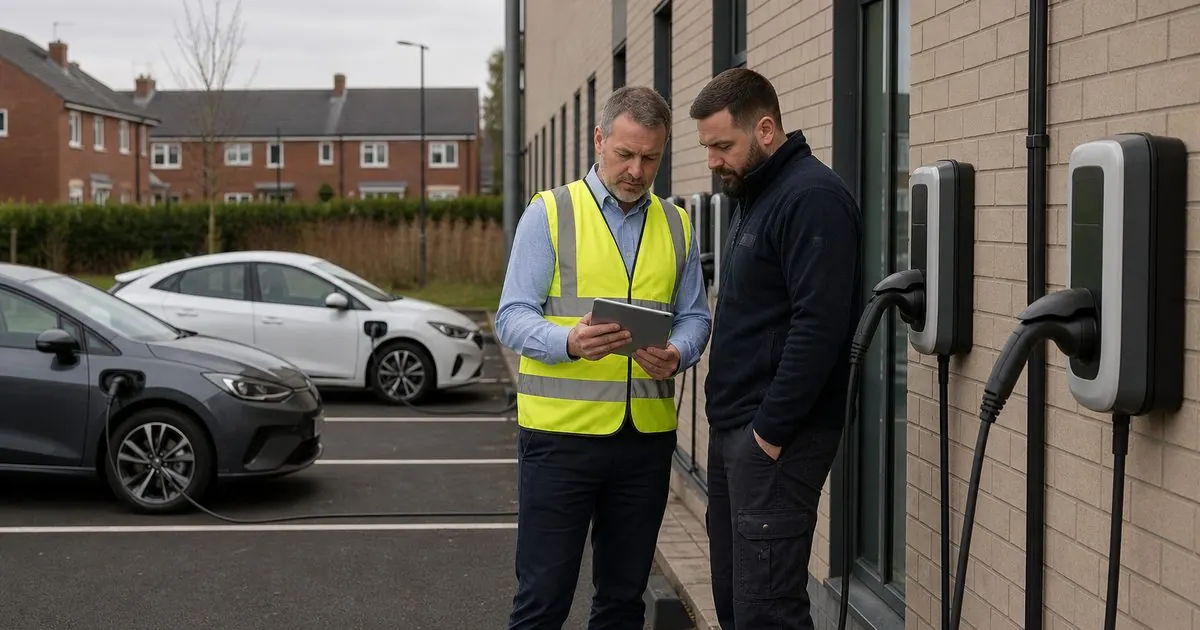
A home charger is a half-day job. A car park of chargers for an office, a hotel or a depot can be weeks of work with a much healthier margin. The catch is the buying process. Instead of one homeowner deciding in a week, you have a managing director, a facilities manager, a finance director, maybe a landlord, all deciding over months.
This article covers who is involved, what the government grant pays, why there is a deadline worth talking about now, and how to market to businesses rather than homeowners.
The grant, and why timing matters (as of November 2026)
The Workplace Charging Scheme (WCS) is the main government support for businesses. According to GOV.UK:
- up to £500 per socket for installations completed from 1 April 2026 (it was £350 before)
- up to 40 sockets across all of an applicant's sites
- capped at 75% of total costs, including VAT
- open to businesses, charities and public sector organisations
- state-funded schools and colleges can get up to £2,000 per socket
- extended for a final year, to 31 March 2027
The installer side matters too. The business applies and gets a voucher code, chooses an installer and passes on the code. The installer must be OZEV authorised, installs, then claims the grant through the installer portal. The work must be done and claimed within 180 days of the voucher being issued.
"Final year" is an honest reason for a business to act now rather than next year. Use it, but use it accurately: if their voucher is issued late, the 180-day window and the scheme end date both matter.
Landlords have their own grant too: up to £500 per socket, up to 200 sockets across all sites, for residential landlords and property management companies, also until 31 March 2027.
Who is involved in the decision
Map the people before you pitch. In a typical small or medium business:
| Role | What they care about |
|---|---|
| Managing director or owner | Staff retention, company image, cost |
| Facilities or office manager | Disruption, maintenance, who looks after it |
| Finance director | Total cost, grant, payback, tax treatment |
| Fleet manager | Charging company cars, driver behaviour |
| Landlord or managing agent | Permission, their building, their power supply |
| Staff | Whether they will actually get to charge |
The person who fills in your form is rarely the person who signs. Your marketing and your proposal must give the first person what they need to sell it internally.
What a winning proposal includes
Business buyers compare proposals side by side. Make yours the easiest to approve:
- A one-page summary. Number of chargers, total cost, grant, net cost, install timeline.
- Power and capacity. What the site's supply can handle, whether load management is needed, and any network upgrade risk. This is often where commercial jobs fall over late, so raise it early.
- Grant handling. Exactly what the client does, what you do and the deadlines.
- Charging policy options. Free for staff, paid, visitor access, fleet only. Facilities managers often have not thought about this.
- Maintenance and support. Who fixes it and how fast.
- A similar job. Photos and a short write-up of a comparable site, with a named contact if they agree.
Marketing to businesses, not homeowners
Google search
Business buyers search with different words. Build separate campaigns and pages for terms like:
- "workplace EV charging installer"
- "office EV chargers [city]"
- "Workplace Charging Scheme installer"
- "EV charging for car park" or "for hotel"
Keep these well away from your home charger campaigns, with their own budgets and their own landing pages.
Landing pages by premises type
A hotel, a dental practice and a warehouse have different reasons to install. Write a page for each type you want: hotels and guest charging, offices and staff retention, depots and fleets, schools with the education grant. Each page should explain the grant, show a similar job and offer a site survey.
LinkedIn and email
LinkedIn lets you reach facilities managers, office managers and finance directors in your area. Use it to share short case studies and the grant deadline, not hard sales messages. Follow up with plain, personal emails.
Partners
Commercial solar installers, electrical contractors without EV accreditation, commercial landlords and managing agents all meet businesses thinking about chargers. Many installers who do commercial solar add chargers to the same proposal. If you do both, see how we approach commercial solar.
A nurture track for long decisions
Commercial EV decisions can take months. Do not let a lead go cold because nobody followed up after the survey. In your CRM, set up a separate business track:
- after the survey: proposal within an agreed number of days
- one week: check the proposal reached the decision-maker
- two weeks: offer a short call with the finance director or MD
- monthly: a relevant case study or grant update
- before the deadline: a clear reminder of the 31 March 2027 date and the 180-day voucher window
For the general approach to long B2B buying cycles, see nurturing commercial leads.
Track commercial work separately
Commercial leads are fewer and bigger. Report them on their own: enquiries, surveys, proposals, value of proposals out, won and lost with reasons. Mixing them into home charger numbers hides both.
How we help
We have no published EV charging results, and we will not claim any. We do run B2B search campaigns, landing pages and CRM tracks for commercial work, including commercial solar for clients like Eco Vision. If you want more workplace EV contracts before the grant ends, book a video call with Tom. We will look at your area and show how Google Ads and the Installer Flow CRM would handle the longer sale.
Sources
- Workplace Charging Scheme: guidance for installers (GOV.UK)
- Changes to electric vehicle chargepoint grant schemes from 1 April 2026 (GOV.UK)
- Electric vehicle chargepoint grants (GOV.UK)
Questions owners ask
How much is the Workplace Charging Scheme grant?
As of November 2026, GOV.UK says up to £500 per socket for installations completed from 1 April 2026, for up to 40 sockets across all sites, capped at 75% of total costs including VAT. The scheme has been extended for a final year to 31 March 2027. State-funded education can get up to £2,000 per socket.
Who claims the Workplace Charging Scheme grant?
The business applies and receives a voucher code, then passes it to its chosen installer. The installer must be OZEV authorised and claims the grant through the installer portal after installation. The work must be done and the claim made within 180 days of the voucher being issued.