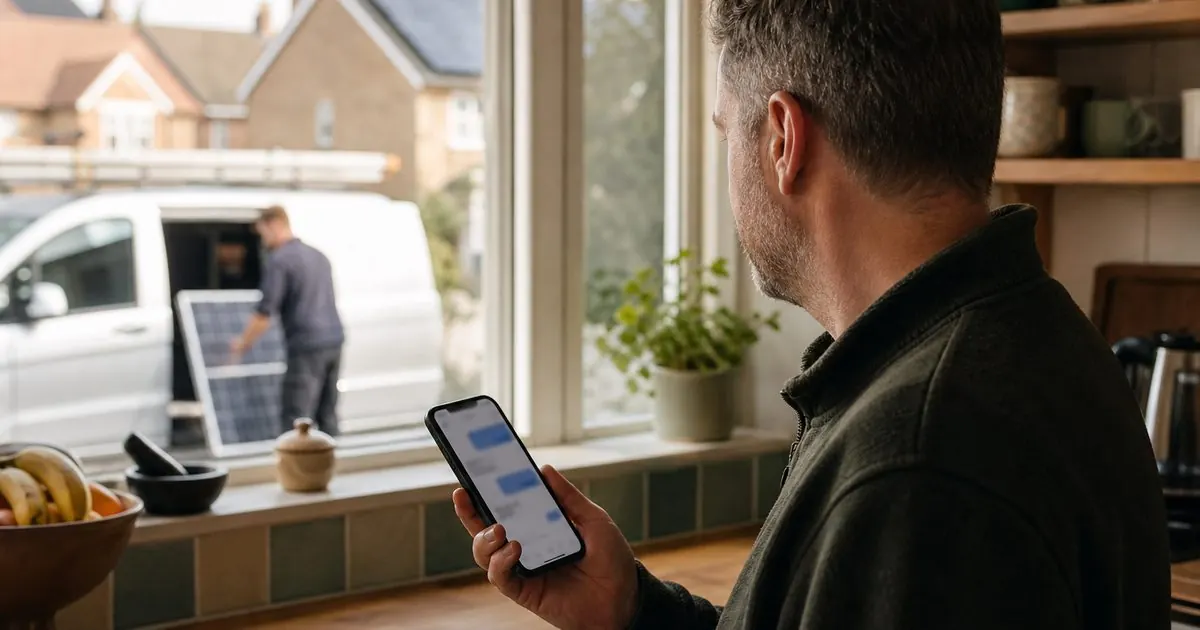
A homeowner in Stoke used to type "solar installers near me" into Google and scroll. More and more of them now open ChatGPT and ask: "Who are the best solar and battery installers near Stoke that offer finance?" They get back three or four names with a line of reasoning for each. If you are not one of those names, you never even make the shortlist.
This guide covers how these assistants decide who to mention, and what a local installer can actually do about it. Google's own AI Overviews work differently and are covered in our piece on AI Overviews, so we will not repeat that checklist here.
How an AI assistant builds a list of local firms
When someone asks ChatGPT a question that needs current information, it can search the web. OpenAI's help pages say ChatGPT search sometimes works with other search providers, rewriting the question into one or more searches, and that it may use an approximate location based on the user's IP address to return local results. It can also pull business listings from third-party providers.
In plain terms, the assistant is doing a fast research job:
- It runs searches for your trade and the town.
- It reads the pages and listings that come back: your website, directories, review sites, local news, forums.
- It looks for facts it can state with confidence: what you do, where you work, how long you have been going, what customers say.
- It writes an answer and cites some of the sources.
Two things follow from that. First, if the assistant cannot read your site, you are relying entirely on what other people say about you. Second, vague marketing copy gives it nothing to work with. "Quality service at competitive prices" cannot be quoted. "MCS certified, fitting air source heat pumps across Staffordshire and Cheshire since 2015, Boiler Upgrade Scheme paperwork handled for you" can.
Step 1: Make sure the assistant can read your website
This is the step most firms miss, and it takes ten minutes to check.
- Check robots.txt. OpenAI uses a crawler called OAI-SearchBot to surface websites in ChatGPT search. Its documentation says sites that block OAI-SearchBot will not appear in ChatGPT search answers (they can still appear as plain navigation links). Some security plugins and hosting firewalls block unfamiliar bots by default. Ask whoever runs your site to confirm it is allowed.
- Know the difference between the bots. GPTBot is used for training OpenAI's models. Blocking GPTBot is a separate choice from blocking OAI-SearchBot. You can opt out of training and still be visible in search.
- Put the facts in text, not images. Accreditation logos, service areas drawn on a map image and prices in a PDF brochure are hard for any crawler to use. Write them out on the page as well.
Step 2: Make your business details identical everywhere
AI assistants cross-check. If your Google Business Profile says "Bright Spark Electrical Ltd", Checkatrade says "Brightspark Electrics" and your website footer has an old phone number, the assistant has less confidence that these are the same firm, and less reason to name you.
Do a one-off clean-up:
- Write down your exact trading name, phone number, website address and, if you show it, your address.
- Search your business name in Google and work through the first three pages of results. Fix every listing you control.
- Claim the listings people forget: Bing Places and Apple Business Connect. OpenAI does not publish its full list of search partners, but these listings cost nothing and feed other assistants and map apps too.
- Use one primary phone number. Tracking numbers are fine in ads, but your core listings should match.
Step 3: Give the assistant pages it can quote
Assistants prefer pages that answer a specific question directly. For a local installer, the pages worth building or tightening are:
- A clear service page per product (heat pumps, solar and batteries, EV chargers) that states what you fit, which brands, typical project length, which grants or finance you can offer, and who you are accredited with.
- An areas page that names the towns and counties you really cover. Be honest. An assistant asked about Shrewsbury will not trust a firm that claims to cover the whole of England.
- An "about" page with real facts: year founded, number of installs (only if you can back it up), named team members, accreditations with membership numbers.
- Project write-ups with the town, the property type, the system fitted and what the customer said. These are exactly the kind of first-hand detail an assistant can cite. See our guide on writing blog content that is not filler.
- A frequently asked questions section that answers what buyers actually ask on the phone, in two or three sentences each.
Structured data helps machines read these facts. Google documents LocalBusiness markup for name, address, phone, opening hours and area served. It is not a magic switch, but it removes ambiguity, and the same markup is readable by any crawler.
Step 4: Get mentioned by other people
An assistant asked "who is good" will look for opinions that are not yours. That means:
- Reviews with detail. "Great job" tells an assistant nothing. "Dan and the team fitted our 5kW battery in Leek in a day and showed us the app" tells it your trade, your town and your strengths. We cover how to get these, within Google's rules, in reviews that rank.
- Accreditation directories. MCS, TrustMark, Gas Safe, NICEIC and manufacturer installer finders are trusted sources. Make sure your listing on each is complete and links to your site.
- Local press and community sites. A school or football club you sponsor, a local news story about a big commercial install, a supplier's case study. One genuine mention on a respected local site is worth more than dozens of low-quality directory links.
Step 5: Test it, monthly
You cannot see an "AI ranking report", so build your own. Once a month, open ChatGPT (and any other assistant your customers use) in a fresh session and ask ten questions a real buyer would ask, for example:
- "Who installs air source heat pumps near [town]?"
- "Best rated solar and battery installers in [county]"
- "Which EV charger installers near [town] can fit a charger the same week?"
- "Is [your business name] a good installer?"
Note who is named, which sources are cited, and whether anything said about you is wrong. The cited sources tell you where to focus. If the same directory keeps appearing and you are not on it, get on it. If an old, wrong phone number is quoted, find where it comes from and fix it.
Results vary by location and by wording, so look for patterns over a few months rather than reacting to one answer.
What not to waste money on
- "AI ranking" packages that promise placement. OpenAI states that there is no way to guarantee top placement.
- Hundreds of AI-written town pages. Google treats mass-produced pages as spam, and assistants gain nothing from fifty near-identical pages. See town pages that are not doorway pages.
- Special "AI files". Google has said publicly that no special machine-readable files are needed for its AI features. Spend the time on content and listings instead.
Where this fits with the rest of your marketing
Being named by an assistant is a trust boost, not a lead machine on its own. For most installers, paid ads and Google still bring in the bulk of enquiries. An enquiry that comes from an AI answer is different: the buyer arrives having already been told you are a sensible choice, so the first call starts warmer. Treat it as part of your wider SEO and GEO work, built on a website that states the facts clearly.
If you want us to run the monthly test for your trade and area and show you who is being recommended instead of you, book a video call and we will go through it with you.
Sources
- OpenAI: Overview of OpenAI crawlers (OAI-SearchBot, GPTBot, ChatGPT-User)
- OpenAI Help Center: ChatGPT search
- Google Search Central: AI features and your website
- Google Search Central: Local business structured data
- Google Search Central: Spam policies (scaled content abuse)
Questions owners ask
Can I pay to be recommended by ChatGPT?
No. OpenAI says there is no way to guarantee top placement in ChatGPT search. What you can control is whether its crawler can read your site, whether your business details match everywhere, and whether there is enough clear, specific information about you online for it to cite with confidence.
Is GEO different from normal SEO?
Mostly it is the same work with a different emphasis. AI assistants lean heavily on clear facts, consistent listings and what other sites and reviewers say about you. A site that ranks well on Google with thin pages and vague claims can still be skipped by an assistant that needs specific details to quote.