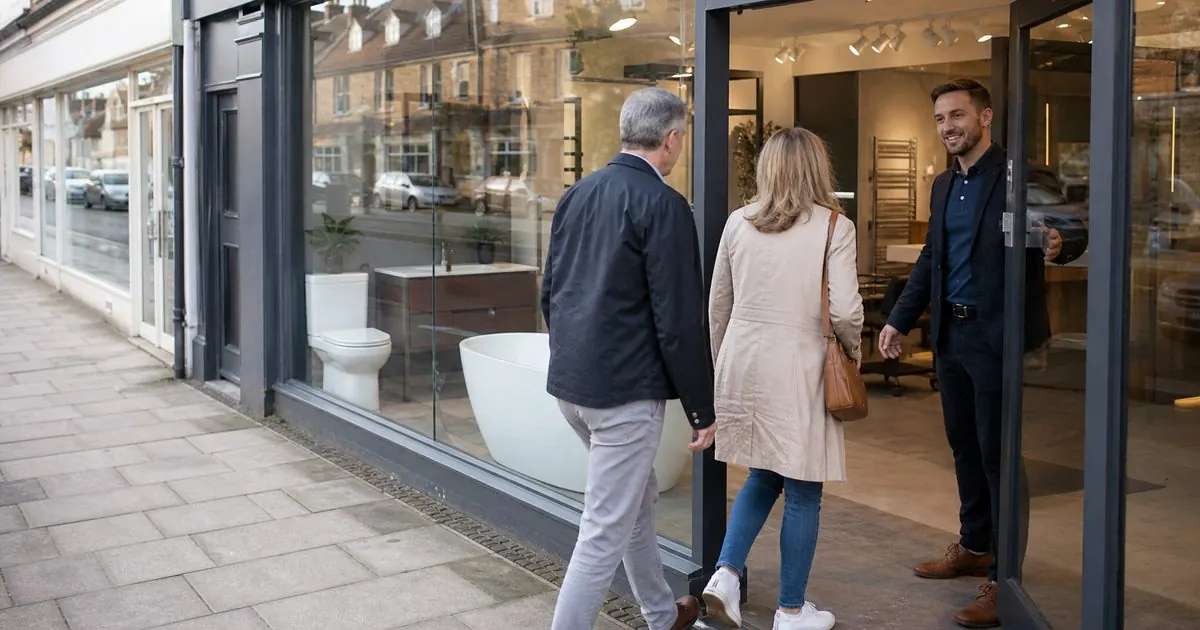
You can spend a fortune on Facebook and Google ads, get a respectable number of form fills, and still have a quiet showroom on Saturday. That gap is common in bathroom and kitchen retail. The ads did their job on paper. The business didn't get what it actually needed, which is people standing in front of your displays with a designer.
The problem is usually not the ad platform. It's that the campaign is built to produce enquiries, and nothing between the enquiry and the showroom door is designed to turn one into the other. This guide fixes that.
Change what the ad is asking for
Most showroom ads end with "get a quote" or "request a brochure". Both send the buyer to a form, and the form sends them to a phone call they may not answer. Neither puts them in the showroom.
Make the showroom visit itself the offer:
- "Book a 60-minute design appointment at our showroom" with a named designer, a time slot and what they will leave with (a layout sketch and a ballpark price, for example).
- Tell them what to bring: room measurements, photos of the current bathroom, a few pictures of rooms they like.
- Remove the friction: parking, opening hours, a weekend slot, children welcome, coffee on. It sounds small. For a couple planning their weekend, it decides whether they come.
A booked appointment with a person's name attached is much more likely to happen than a vague "pop in sometime".
Let them book a time, not a callback
The best showroom funnels end in a calendar, not a "we'll be in touch". After a few qualifying questions (project type, rough timing, budget band), show the designer's available slots and let the buyer pick one. Then confirm instantly.
What happens next matters as much as the booking:
- Instant confirmation by text, email or WhatsApp, with the date, time, address, the designer's name and photo, and a map link.
- A "what to bring" message two days before.
- A reminder the morning before, with an easy way to rearrange rather than just not turning up.
- A short video from the designer saying hello and showing a display they think the buyer will like.
Rearranging should be one tap. People who can easily move an appointment usually do. People who can't, often don't come. The broader no-show playbook is in no-shows and one-person appointments.
Google: catch the people already looking
Google is where people search "bathroom showroom near me" and "kitchen showroom [town]". Make sure you are visible and the next step is obvious:
- Google Business Profile: correct opening hours (including bank holidays), lots of recent photos of the displays, an appointment link straight to your booking calendar, and reviews that mention the showroom and the designer by name.
- Search ads with location assets, so your address and distance show in the ad.
- Call assets during opening hours, routed to someone in the showroom who can book a slot on the spot.
- Separate campaigns for "showroom" searches and "fitter" searches. Someone searching "bathroom fitters near me" may want a quote at home. Someone searching "bathroom showroom" wants to look and touch. Send each to the right landing page.
Meta: create the visit before they search
Facebook and Instagram are where you put the idea in someone's head before they are ready to Google it. For a showroom, that means:
- Drive-time targeting. Set your audience around how far people will realistically travel to you, not a round number of miles.
- Show the showroom, with people in it. A 20-second walk through the displays with your designer talking is far stronger than a stock photo of a bathroom.
- Use real customers. "We came in with a photo from Pinterest and left with a plan" is the kind of line that books appointments.
- Promote events. A design evening, an open weekend or a new display launch gives a reason to come now rather than "one day".
Track the visit, not just the form
This is where most showroom marketing falls down. If the only thing the ad platforms see is a form fill, they will keep finding people who fill in forms, not people who turn up.
Set your CRM up so every enquiry carries its source (which ad, which campaign, which keyword), and the appointment record shows booked, attended, no-show and order won. Then send the "attended" and "order" events back:
- Google Ads can import offline conversions, so it learns which clicks led to real visits. Google is moving these imports to its Data Manager API after June 2026, so check the current setup method in Google Ads Help.
- Meta takes the same kind of event through its Conversions API.
For walk-ins who never filled in a form, ask at the desk how they heard about you and log it in the CRM. A tablet at reception with three taps ("Google", "Facebook or Instagram", "recommended") is enough.
Now you can report the numbers that matter: cost per booked visit, cost per attended visit and cost per order, by campaign. The bigger picture on tying spend to sales is in which marketing actually makes you money.
A simple weekly showroom scorecard
| Number | Why it matters |
|---|---|
| Visits booked from ads | Shows the offer and funnel are working |
| Attendance rate | Shows the confirmation and reminder flow is working |
| Designs presented | Shows designers are converting visits into projects |
| Orders and average order value | Shows the whole path is paying |
| Cost per attended visit | The number to judge each campaign by |
If bookings are high but attendance is low, fix the reminders. If attendance is fine but orders are low, look at the design process or the price positioning, not the ads.
How we help
We build ads, booking funnels, reminders and tracking for home improvement firms as one joined-up system, using our own CRM, Installer Flow, so every visit traces back to its source. See how it fits bathrooms and kitchens, or read about our Google Ads work.
If your showroom is quieter than your ad reports suggest it should be, book a video call. We'll look at what happens between the ad and the door.
Sources
Questions owners ask
Is it better to advertise showroom visits or home design visits?
Offer both, but lead with the showroom if it is good. A showroom visit costs you no travel, lets buyers touch products and usually produces a bigger order. Keep the home visit for buyers who cannot travel, and for the measure once the design is agreed.
How do I know which ad brought a showroom visitor?
Capture the visit as a booked appointment in your CRM, linked to the original enquiry and its ad source. When the visitor arrives, mark them as attended. That status can be sent back to Google and Meta. For walk-ins, ask how they heard about you and log it at the desk.